FREE TEMPLATE

A free character relationship chart template

A printable chart for the people in your story and what they are to each other, written in both directions. Three pages: how to fill it, a blank chart with eleven cards, and a worked example from A Christmas Carol. Print it, or start the same chart in Loomworld, where it stays linked to your manuscript.

Download the PDFStart it in Loomworld instead

PDF · A4 landscape · 3 pages · free to use and adapt

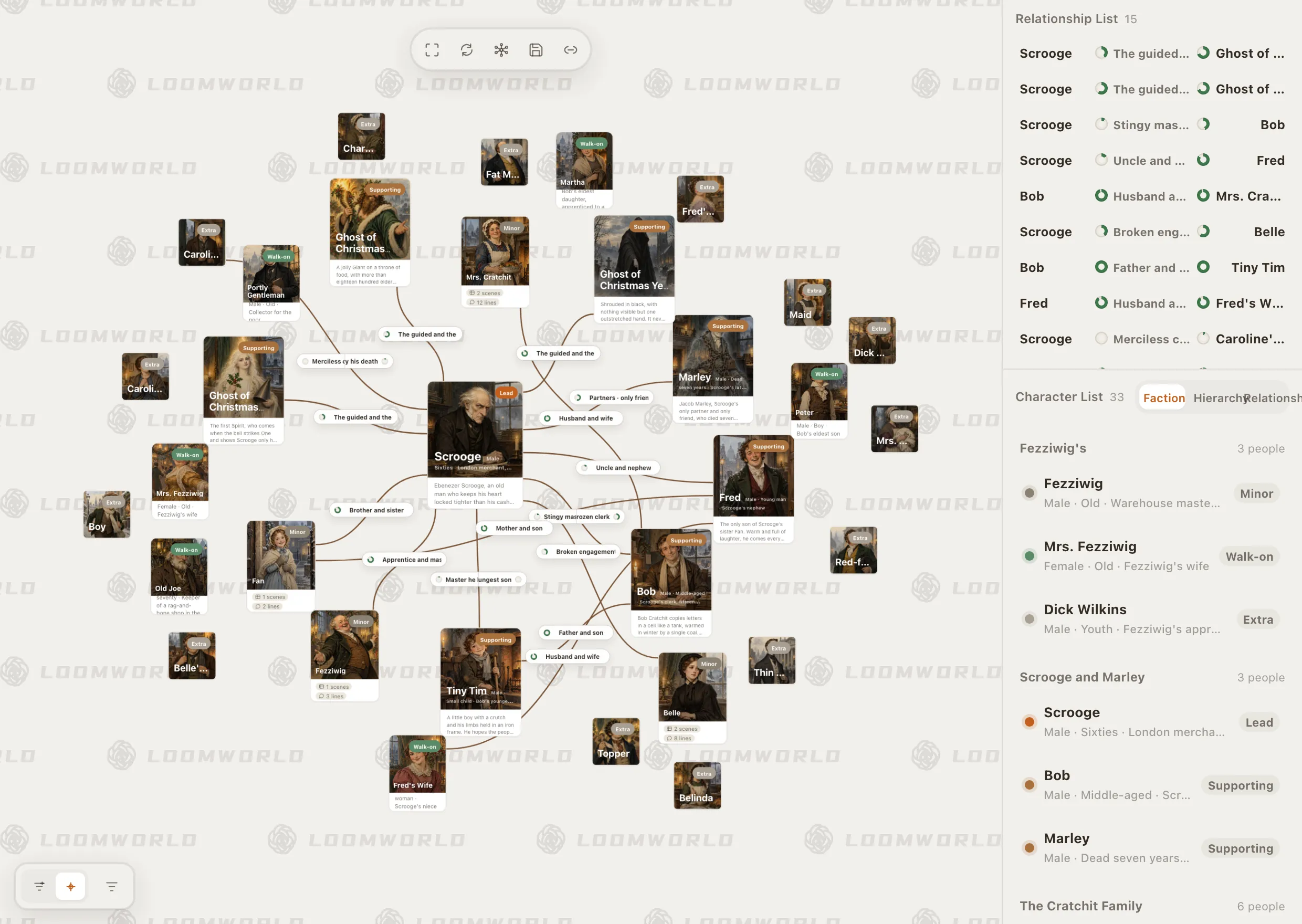
Loomworld character module: the relationship canvas for A Christmas Carol, with Scrooge at the centre, and the character list grouped by faction

Why most relationship charts stop helping

01

Labels without conflict

“Brothers”, “mentor”, “rival”. A chart of labels tells you who is related, not what they want from each other, so it never suggests a scene.

02

One word for two people

A relationship has two ends. She thinks they are friends; he thinks she is a mark. A single line with a single word hides the most useful thing on the page.

03

A snapshot of a moving story

By chapter twenty the allies have fallen out and the stranger is family. A chart drawn once at the start is wrong by the middle of the book.

What is in the template

A method, not just boxes

Page one is six short rules: put the lead in the middle, add only people who change a decision, write every line in both directions, name the conflict rather than the label, mark the chapter where a line turns, and use a dashed line for people who share scenes without a defined bond yet.

  • Lead in the centre
  • Both directions on every line
  • Dashed lines for “shares scenes, no bond yet”

A blank chart with eleven cards

The lead in the middle, six close characters around them and four outer cards for the people one step removed. Each card has room for a name and a role or goal; each capsule has room for how A sees B and how B sees A.

A worked example: A Christmas Carol

Scrooge and the people of Stave One, filled in. Read the split capsules: Scrooge calls Fred a nuisance, Fred calls him an uncle he won't give up on. That gap between the two words is the story's last scene, and it is what the two-direction method is for.

The same chart in Loomworld

In Loomworld the chart is the character module. You draw each relationship yourself; switch on Bidirectional Perspective to give the line a word for each direction, add metrics you name, such as trust or loyalty, and keep longer notes on the line. Dynamic Slices show the web as it stands in one chapter.

Co-appearance links are a separate dashed layer counted from the scenes where two characters both speak. They are a hint you can turn into a relationship, never a relationship invented for you.

How the character module works

  • A word for each direction
  • Named metrics per relationship
  • One chapter's web at a time

How to use it

  1. 1

    Start with six names

    The lead and the five people whose choices change theirs. Add the outer ring only when the inner one is full.

  2. 2

    Write both ends of every line

    For each pair, one word for how A sees B and one for how B sees A. If the two words match, write one; if they don't, you have found a scene.

  3. 3

    Redraw it per act

    Print a fresh chart at each turning point. Comparing the act one and act three charts shows your arcs at a glance.

Paper, whiteboard app or Loomworld?

All three work. The difference is whether the chart knows anything about your manuscript.

CapabilityLoomworldThis PDFWhiteboard app
PriceFree planFreeFree to paid
Works without an account——
A word for each directionManual
Relationships per chapterOne sheet per actManual
Shared-scene counts from the draft——
Export the chart as an image—Print it

Compared October 2026. Whiteboard apps such as Milanote or Miro are general-purpose; their templates vary.

Frequently asked questions

What is a character relationship chart?

A diagram of the characters in a story and how they are connected: family, alliances, rivalries, debts, secrets. Writers use it to keep a large cast straight and to find conflict between characters before drafting scenes.

How many characters should go on one chart?

Six to ten. Put the lead in the middle and include only people whose choices change the plot. A very large cast reads better as one chart per faction or per act.

Why write each relationship in both directions?

Because characters rarely see each other the same way. One-sided love, betrayal, a secret and a misunderstanding all live in the difference between how A sees B and how B sees A.

Is the template really free?

Yes. Download it, print it, change it and use it for your own books and scripts. No account or email needed.

Can Loomworld draw the chart from my manuscript automatically?

No. You draw relationships yourself. Loomworld can show a separate dashed layer of co-appearances, counted from scenes where two characters both speak, and the AI can propose a relationship card that you approve.

Can I export my Loomworld chart as an image?

Not yet as a single image file. The chart lives in the project, which you can export as a whole.

Let the chart move with the book

Start a Loomworld project for free and draw the same chart on a canvas that shows each chapter's web of relationships.