FORESHADOWING TRACKER

A foreshadowing tracker that shows what you never paid off

Every setup is a promise to the reader. Loomworld records where you planted it, where you reminded the reader, and where you collect it, then draws the distance across your chapters and flags the threads that have waited too long.

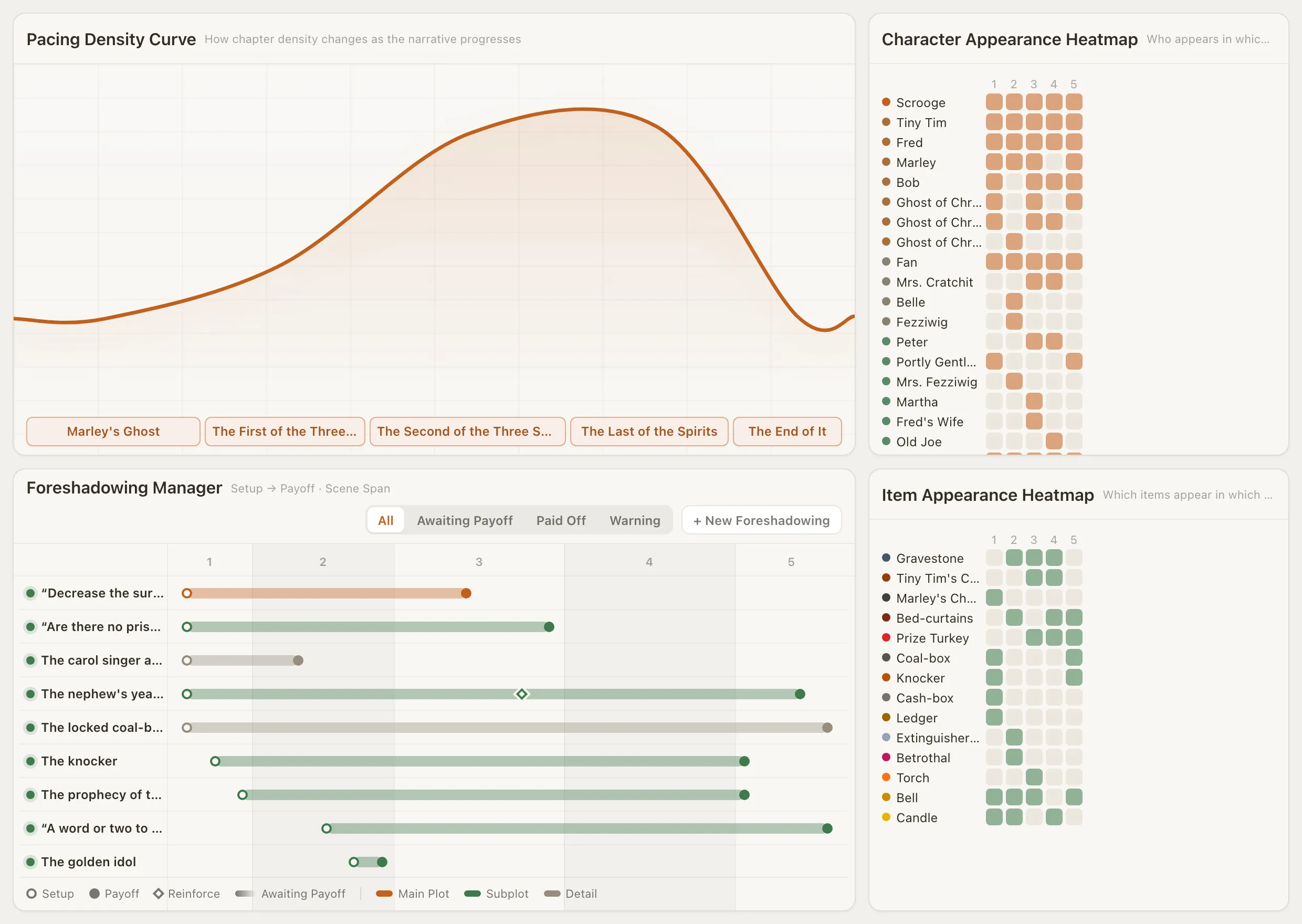
Loomworld Beats page: pacing density curve, character and item appearance heatmaps, and the Foreshadowing Manager showing setup-to-payoff spans across five chapters

Foreshadowing goes wrong in three predictable ways

01

Planted and forgotten

A locked box in chapter three, a stranger at the funeral in chapter seven. Two hundred pages later nobody, including the author, remembers to open the box.

02

No sense of distance

Paid off one chapter later, a clue feels cheap. Paid off forty chapters later with no reminder, it feels unearned. In a notes file you cannot see either problem.

03

Revisions break the chain

Move a scene, cut a chapter, and the note that said “planted in 3.2” now points at nothing. The tracker is wrong exactly when you need it most.

How the tracker works

Setup, reinforce, payoff, on one bar

Each foreshadow has anchors: where it is set up, any number of reinforcements where you nudge the reader again, and the payoff. Anchors point at a real chapter, scene, scene setting or block of your draft, not at a page number.

The Foreshadowing Manager draws each thread as a bar across your chapters, with small marks for reinforcements. A thread reminded three times and one planted once and left alone look completely different.

  • Anchors on chapters, scenes or single blocks
  • Any number of reinforcements
  • Span measured across the book
Loomworld Beats page: pacing density curve, character and item appearance heatmaps, and the Foreshadowing Manager showing setup-to-payoff spans across five chapters

A status you never have to maintain

Status is inferred from the anchors, so there is no second record to keep in sync. A setup with no payoff is Awaiting Payoff. Both ends anchored is Paid Off. A payoff with no setup yet is flagged too, for when you wrote the ending first.

  • Not Set Up
  • Set Up (payoff first)
  • Awaiting Payoff
  • Paid Off

Overdue warnings that scale with your book

A thread that waits too long turns into a warning, and warnings sort to the top of the list. The threshold grows with your book: at least six chapters, or forty percent of all chapters, whichever is larger. A hundred-chapter epic is not nagged after five chapters, and a short novel still gets the warning.

  • Filters: All, Awaiting Payoff, Paid Off, Warning
  • Warnings first, then awaiting

Record the craft, not only the clue

Each foreshadow records how it works: technique (explicit setup, subtle setup, misdirection, recurring thread, callback), hint strength from obvious to hidden, importance from main plot to easter egg, and the effect you expect at payoff.

Link related foreshadows into a chain, so changing one shows you the others. Notes can @-mention the characters, places and props involved.

  • Technique and hint strength
  • Main plot, subplot or detail
  • Linked chains of foreshadows

Tell Quill, get a card

Say “note a foreshadow: the letter that was never sent” or “this thread should pay off in chapter eight” in the chat. Quill returns a confirmation card that creates or updates the foreshadow, with anchors pointing at real places in your draft.

The tracker never guesses on its own: no foreshadow appears unless you or a card you approved put it there. Delete a chapter and the anchors that pointed at it are removed instead of left dangling.

How chat proposals work

Three habits that pay for themselves

  1. 1

    Outlining: anchor at chapter level

    Decide “planted here, collected there” and the span bar shows at once how far apart they are.

  2. 2

    Drafting: pin the setup, leave the payoff open

    Anchor the setup to the scene where it happens. It waits in the list as Awaiting Payoff until you reach the right chapter.

  3. 3

    Revising: add reinforcements

    Anything that recurs gets a reinforcement anchor. The bars then show which threads the reader has had time to forget.

Loomworld compared with the usual ways to track foreshadowing

A spreadsheet, a Notion database or a printable tracker can all list your clues. What they cannot do is stay attached to the draft.

CapabilityLoomworldSpreadsheet or NotionScrivenerPrintable tracker
Anchors point at real scenes in the draft—Manual links—
Setup-to-payoff span drawn across chaptersBuild it yourself—Draw it by hand
Overdue warningFormulas you write——
Anchors cleaned up when a chapter is deleted———
Technique, hint strength and importanceColumns you addKeywordsColumns you add
Create entries by asking an AI———

Compared October 2026 from each product's public documentation. Tell us at [email protected] if something has changed.

Frequently asked questions

What is a foreshadowing tracker?

A record of every setup in a story and where it pays off. A good tracker also shows how far apart the two are, whether you reminded the reader in between, and which threads are still open.

How do writers keep track of foreshadowing?

Most use a spreadsheet, a notebook or a Notion database with one row per clue. That works until the draft changes. Loomworld anchors each clue to the actual scene, so the tracker moves with the manuscript and computes the span and status for you.

How far apart should a setup and its payoff be?

There is no fixed rule, but very short spans tend to feel obvious and very long ones need reinforcement so the reader still remembers. Loomworld warns you once a thread has waited at least six chapters or forty percent of the book, whichever is larger.

Does Loomworld detect foreshadowing automatically?

No. The tracker records what you tell it. You can create entries yourself, or ask Quill in the chat and approve the card it returns. Nothing appears on its own, and marking a payoff never changes your draft.

Can I track red herrings too?

Yes. Misdirection is one of the technique types, next to explicit setup, subtle setup, recurring thread and callback.

Does it work for screenplays?

Yes. Loomworld is a writing desk for novels and screenplays, and the tracker anchors to chapters, scenes and scene settings in either.

Stop keeping your foreshadowing in your head

Start a project for free, plant your first thread, and see how far it has to travel.