AI FOR NOVELISTS

An AI writing tool that remembers characters, chapters and the rules of your world

Ask “where is Wren at the end of chapter 12, and does she know about the letter yet?” and get an answer from your book, not a guess. Loomworld keeps your characters, places and world rules as records in the same project as the draft, and keeps summaries of each chapter up to date in the background. Its AI, Quill, reads those first, then opens the chapters a question needs.

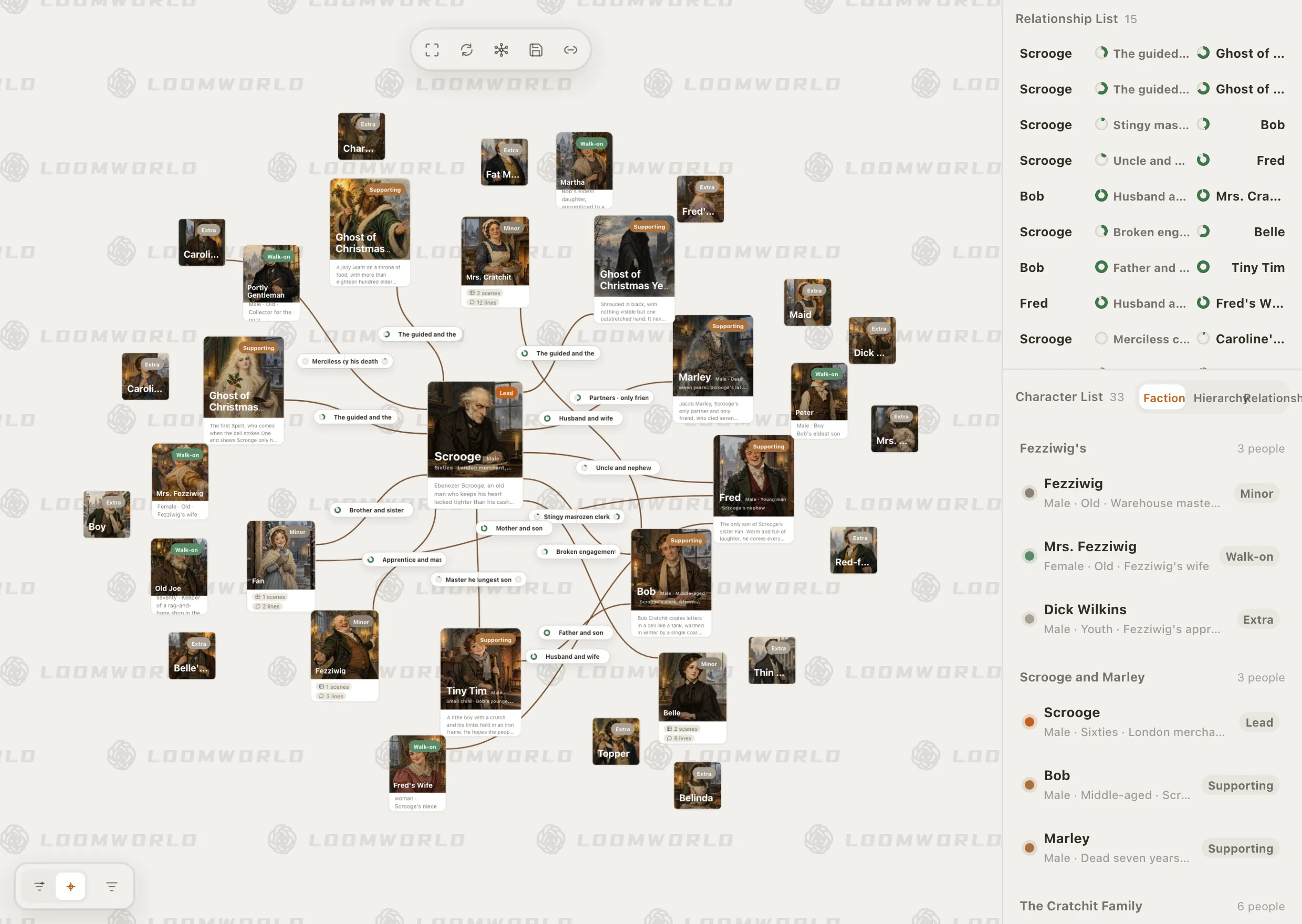
Loomworld character module: the relationship canvas for A Christmas Carol, with Scrooge at the centre, and the character list grouped by faction

Why the AI keeps forgetting who is who

01

Re-pasting the background

A chat with no shared project context starts empty. You copy in the character notes and recent chapters again, and anything you leave out, the AI fills in with a guess.

02

Files that go out of date

Uploading the manuscript to a chatbot project helps until you revise. Unless the file is connected to a live source, the AI keeps reading the version you uploaded.

03

Facts that change by chapter

She is a guard in chapter 3 and a rebel in chapter 20. If your notes only record who she is now, the AI can apply the late version to the early chapters.

How Loomworld's AI remembers your book

Summaries that catch up with the draft

About 15 minutes after you stop typing, Loomworld starts updating, one item at a time: scene and chapter summaries, an overview of the whole story, profiles of the lead and supporting characters in the chapters you changed, and continuity reports. Summaries and chapter intentions you wrote by hand are locked and never overwritten.

This background upkeep refreshes summaries and profiles without asking first. It never edits your manuscript, and you can switch it off in the project's AI settings.

Quill reads before it answers

When you ask a question, Quill reads the summaries first, then opens the chapters and records the task needs. Long manuscripts are read in pieces, and if something is too long for the model it tells you rather than quietly cutting it short.

That lets it follow a trail through characters, relationships and scenes: where someone was, what they knew and when, which chapter first stated a rule.

AI collaboration overview

Loomworld character module: the relationship canvas for A Christmas Carol, with Scrooge at the centre, and the character list grouped by faction

Characters are records, not a paragraph in a prompt

Each character has a card with aliases, factions, relationships and an arc. Turn on the Activity toggle for age, occupation, faction or phase status (their state at that point in the story) and record a new value at the chapter where it changes, so “who is she in chapter 20” has one answer.

When you commit a speaker line in the editor, Loomworld creates a character card if no existing name or alias matches. The AI reads the same records you do.

  • Aliases, factions, relationships and arc
  • Values that change at a chapter
  • Character cards created from speaker lines

Changes to your draft come back as proposals

When you ask Quill to change your draft or your story bible, you get a confirmation card with the before and after. Apply it or drop it; one undo reverses an applied card. If the text changed after the card was made, the card is refused rather than written over your newer version.

What it will not do

Quill is not an autopilot. It does not plan your next scene unasked or touch your draft while you are away, and it can be wrong, so check what it tells you. It needs a sign-in, an active subscription and cloud sync turned on for the project. Loomworld does not use your manuscript to train or improve AI models.

Get an AI that knows your book in three steps

  1. 1

    Bring the draft in

    Write in the editor, paste chapters in, or attach a DOCX or TXT and choose “This is my draft”. That import sorts the text into chapters and scenes without changing your words, after showing the estimated credits.

  2. 2

    Turn on cloud sync

    Quill works on synced projects. Summaries and character profiles fill in as background upkeep catches up.

  3. 3

    Ask about chapter 40

    Ask a question you would normally have to look up: where someone was, what they knew, when a rule was first stated.

Loomworld compared with a chatbot project

General chatbots do far more than this: any topic, web search, a choice of models. The difference here is what the AI works from and how its answers reach your draft.

CapabilityLoomworldChatbot project with uploaded files
What it readsYour draft and story records in the projectFiles and instructions you add
After you reviseSummaries refresh in the backgroundRe-upload, unless connected to a live source
Character facts by chapterAge, occupation, faction, phase statusWhatever your notes say
How changes reach your draftProposals you approveYou copy them back by hand
Talk about anything, search the web—
Pick your own model—Depends on the product

General comparison with chatbot project features such as ChatGPT Projects and Claude Projects, which vary by product and plan. Checked 3 November 2026.

Frequently asked questions

What happens when I revise a chapter or change a character?

Your draft and character cards update at once. Summaries and AI profiles catch up in the background, about 15 minutes after you stop typing, so for a while they can lag behind your latest change. Anything you wrote by hand is locked and not overwritten.

Does it really remember the whole novel?

It does not hold the entire book in one prompt, and it does not reread every word for every answer. It reads current summaries of each chapter and the whole story, then opens the specific chapters and records a question needs. That helps it find the right context across a long manuscript.

Will it write the book for me?

That is not what it is for. Quill can continue a scene or rewrite a passage when you ask, and you preview the result before it goes into your draft. The point is an assistant that knows your book, not one that writes it.

Can it be wrong?

Yes. AI can miss something or misread an intentional twist. Treat its answers as a quick look-up you check, not as the final word.

Is my manuscript used to train AI?

No. Loomworld does not use your text to train or improve any model. It goes to model providers only to run AI tasks: the ones you start, and background upkeep while it is switched on.

What does it cost?

Quill, the AI, needs a subscription, from US$4.99 for 30 days, and cloud sync turned on for the project. The editor and story bible stay free.

Stop re-pasting your cast list

Start a project with your draft, let the summaries catch up, and ask Quill something you would normally have to look up.